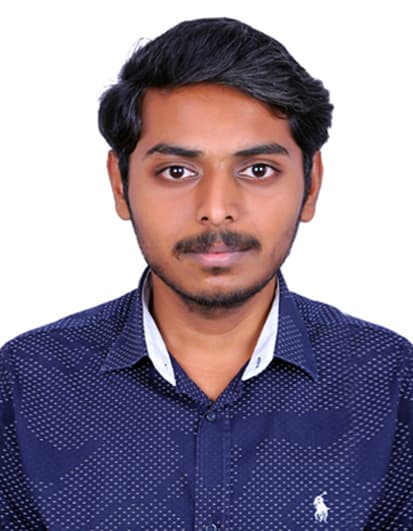
hey, I'm
Open to fellowships & collaborations

Divyansh
Teja Edla

A leader who codes — building AI for the India nobody else is building for. Federated learning, Indic NLP, and 40 people who ship things with me.

Hyderabad, India · 2026
Divyansh Teja Edla
CSE · Final Year

Hey — thanks for stopping by.

I'm not here to impress you with buzzwords. I'm here because I genuinely believe technology should work for people who've been left out of the story — the kirana store owner, the rural doctor, the Telugu storyteller.

Everything on this page comes from that belief.
If that resonates with you, let's talk.

— Divyansh
Written in Hyderabad, 2026
// about me

I'm a final-year Computer Science student at Matrusri Engineering College, Hyderabad— and the “student” label feels too small for what's actually been happening.

I've spent the last year building things that matter: a multi-agent AI system for digitising small businesses, a federated learning algorithm that's fairer to under-resourced hospital clients, and an agentic RAG system that keeps Telugu literature alive through AI.

I also founded and lead DevCatalyst— a 40-member technical community I built from scratch starting August 2025. We've run 8+ events reaching 1500+ students. Not because I had to, but because the best way to grow is to bring people with you.

I'm looking for fellowships, collaborations, and conversations with people who want to use AI to fix real things — not just build another chatbot.

CurrentlyFinal year, CSE
CollegeMatrusri Engg. College, Hyd
RolePresident & Founder, DevCatalyst
ResearchFederated Learning · Indic NLP
StackPython · PyTorch · LangGraph
DatasetsTelugu OCR · 120k rows on HF
Looking forFellowships · Collabs · Impact
LocationHyderabad, India
// devcatalyst — built from zero
Visit site
Community Members
0+
Across all four years — first years to final years, all shipping together
Events Delivered
0+
Technical, community, and collaborative — none half-done
Students Reached
0+
Real students at real events — not a slide metric
Since
Aug '25
From an idea in August 2025 to a community that runs itself
01
Aug 18, 2024
Inauguration & Git/Dify AI Session
Club kickoff — essential Git commands + building an AI chatbot with Dify AI. 60+ attendees, led by Nikhil Sai Siddhardha.
You don't need resources to start — you need a clear enough vision that people show up anyway.
02
Aug 22, 2024
Algorand Builders Workshop
Intro to Web3 and smart contracts on Algorand blockchain — transparency, immutability, and decentralised compute. 75+ attendees.
Pulling in adjacent tech (Web3) builds breadth that pure ML-focused clubs never develop.
03
Sep 24, 2024
Agentic AI Workshop
Hands-on build: PDF Document Assistant using FastAPI, Gemini AI, Pinecone, MySQL, Streamlit. 50+ attendees, led by Vijender P.
The best teachers are people who just learned it themselves — the gap is small enough to feel safe.
04
Sep 25, 2024
SIH 2024 Internal Hackathon
Internal hackathon for Smart India Hackathon preparation, supported by Mrs. Samatha (SPOC). Cross-team collaboration at scale.
Silos inside a college are as real as silos in a company. Breaking them creates unexpected energy.
05
Dec 13, 2025
Cloud Exploration: AWS & Beyond
Beginner-friendly deep dive into AWS cloud services and infrastructure. 30+ students. Led by Rudramadhaba Mishra.
Accessible sessions create new builders — not everyone starts with AI.
06+
2025–26
Career Exchange, GDC Collab & AWS IAM Security
AIESEC career workshop, 'Build with AI' at Google Development Center, and AWS IAM intermediate session (Aric Pandya). Growing the event format diversity.
The most memorable events happen at the intersection of two things that don't usually go together.
// selected work — case studies
Flagship · Agentic AI · 2026

Digi-Biz — Agentic Business Digitization

Making 63 million invisible Indian businesses visible online

8
AI Agents
Each does one thing well — file discovery through profile output
5+
Input Types
PDFs, DOCX, images, videos, and spreadsheets
< 2 min
Processing
Full business profile from raw documents
95%
Completeness
Service extraction accuracy after multi-stage pipeline
The Problem

India has 63 million small businesses. Most are invisible online — not because they don't matter, but because no one built them the right tool. A shop owner has receipts, photos, and price lists — but no website, no structured data, no digital presence.

The Approach
  • Designed a multi-agent LangGraph pipeline where each agent handles one stage of document understanding
  • File Discovery Agent scans uploaded ZIPs and routes documents by type (PDF, DOCX, images, videos)
  • Specialized agents extract tables, parse text, and analyze media in parallel
  • Schema Mapping Agent structures extracted data into a unified business schema
  • Validation Agent checks for consistency and completeness before final output
Stack
LangGraphFastAPIGroq / Llama-4-ScoutStreamlitDocker
Why it's different

The key insight was that a monolithic LLM call fails on messy real-world documents. Breaking it into 8 specialized agents — each with a focused prompt and clear responsibility — increased extraction completeness from ~60% to 95%.

Healthcare AI · Federated Learning · Research · 2025

FL-QPSO Brain Tumor AI Suite

Fair federated learning for hospitals that don't have 10,000 scans

0.76
Mean Dice
3D segmentation on BraTS 2021 whole tumor
0.85
TC Dice
Tumor Core segmentation accuracy
0.79
ET Dice
Enhancing Tumor — the hardest sub-region
3
FL Methods
FedAvg vs FedProx vs QPSO-FL compared
The Problem

In federated learning across hospitals, larger institutions dominate model performance. Standard FedAvg averages weights proportionally — so a hospital with 5,000 scans drowns out a rural clinic with 200. The patients who need AI most get the worst model.

The Approach
  • Replaced FedAvg weight aggregation with Quantum-inspired Particle Swarm Optimization (QPSO)
  • QPSO explores the weight space stochastically, finding aggregation points that reduce performance variance across clients
  • Built 3D Attention U-Net for volumetric brain tumor segmentation on BraTS 2021 (4 MRI modalities)
  • Compared FedAvg vs FedProx vs QPSO-FL across 3 simulated hospital nodes with Non-IID data splits
  • Added LSTM-based tumor progression prediction as a downstream clinical module
Stack
PyTorchMONAIFederated LearningQPSO3D Attention U-NetResNet-18
Why it's different

Fairness in medical AI isn't just ethics — it's clinical. A model that degrades for rural hospitals fails the patients who need it most. QPSO-FL reduces cross-client Dice variance by finding aggregation weights that don't just optimize for the average — they optimize for the floor.

Indic NLP · Multi-agent · 2026

Telugu Agentic RAG System

AI that thinks in Telugu, not just translates into it

92%
RAG Hit Rate
@ top-1 retrieval on Chandamama corpus
99%
@ Top-5
Near-perfect retrieval at top-5 results
~0.95
MRR
Mean Reciprocal Rank on synthetic query benchmark
10k+
Stories
Classic Telugu stories indexed and searchable
The Problem

Telugu is spoken by 80 million people. Most AI produces 'translated English' — grammatically passable but culturally hollow. Quality Telugu storytelling requires a system that understands the language's idioms, pacing, and literary tradition, not just its grammar.

The Approach
  • Built a multi-stage cognitive loop: Plan → Draft → Critique → Polish
  • Planning Agent retrieves culturally relevant context from a 10,000+ story corpus via semantic search
  • Drafting Agent generates Telugu text grounded in retrieved context using GPT-OSS-120B
  • Validator Agent acts as a senior editor — rejects drafts using passive voice, lazy descriptions, or cultural inaccuracies
  • Multiple revision cycles until the Validator passes the output — quality enforced architecturally, not prompted
Stack
Multi-agentQdrantGTE MultilingualGemini APIStreamlit
Why it's different

The Validator Agent is the innovation. Without it, outputs are 'good enough but hollow.' The Validator checks for show-don't-tell, native idiom usage, and cultural accuracy — and sends drafts back until they pass. Quality is enforced by architecture, not by prompt engineering.

Cultural AI · RAG · 2025

Chandamama Studio

Preserving Telugu literary heritage through engineering

10k+
Stories Indexed
Chandamama archive digitized and searchable
5
LLMs Compared
Council of Storytellers creative writing experiment
92%
RAG Accuracy
Top-1 retrieval hit rate
6
Analytics
Author, character, location, genre, timeline, themes
The Problem

Classic Telugu literature — stories, poems, serials from the iconic Chandamama magazine — exists in physical archives slowly disappearing. No structured digital corpus exists. Without one, this cultural heritage is one generation from being lost.

The Approach
  • Digitized and indexed 10,000+ stories from Chandamama archives into a vector database
  • Built semantic search over the corpus using Alibaba-NLP/GTE Multilingual embeddings
  • Created a 'Council of Storytellers' — 5 LLMs generating from the same prompt, judged on literary quality
  • Evaluation criteria: Show-Don't-Tell, pacing, native idiom usage, cultural authenticity
  • Added author analysis, character mapping, and location-based story graphs as analytical tools
Stack
RAGQdrantGTE MultilingualOpenAIStreamlitMongoDB
Why it's different

This isn't just a chatbot. The 'Council of Storytellers' is a research experiment: five LLMs given identical prompts, outputs judged on literary quality, not just fluency. The result: some models write beautifully but miss cultural context; others nail culture but produce flat prose.

Indic NLP · Tools · 2025

Telugu Chandassu Identifier

A rare case where domain knowledge beats machine learning entirely

0
Training Data
Pure linguistic rules — no ML, no dataset needed
L/G
Classification
Laghu/Guru syllable weight analysis
pip
Library
Planned release as Python package
Verses
Works on any Telugu padyam
The Problem

Telugu poetry has a rich tradition of prosodic meters (Chandassu) — Vritta, Jati, Upajati padyam — that modern NLP tools completely ignore. No existing tool can classify Telugu verse meters or analyze syllable weights (Laghu/Guru).

The Approach
  • Studied Telugu prosody rules from classical grammar texts — no training data needed
  • Built a rule-based engine that decomposes Telugu text into syllable units
  • Each syllable classified as Laghu (light) or Guru (heavy) based on vowel length and consonant clusters
  • Pattern matched against known Chandassu meters from classical Telugu poetry treatises
  • Planning to release as a standalone pip-installable Python library
Stack
PythonRegexStreamlitTelugu NLP
Why it's different

No dataset needed — pure linguistic rules. This is a rare case where deep domain knowledge beats ML entirely. Understanding Telugu phonology and classical prosody was harder than any model training would have been.

ML · Explainability · 2024

CC Fraud Detection + Explainability

Detection is half the problem. Explanation is the other half.

284k
Transactions
Full dataset with 0.17% fraud rate
SHAP
Explainability
Per-feature attribution for every prediction
5
Models
XGBoost · RF · LR · KNN · Hybrid Stacking
SMOTE
Imbalance
Synthetic oversampling for minority class
The Problem

Credit card fraud detection models achieve high accuracy, but banks and analysts can't deploy what they can't explain. A flagged transaction with no explanation is useless — analysts need to know which specific features drove the prediction to trust and act on it.

The Approach
  • Trained multiple classifiers: XGBoost, Random Forest, Logistic Regression, KNN, and a Hybrid Stacking ensemble
  • Applied SMOTE to handle extreme class imbalance (0.17% fraud in 284,807 transactions)
  • Integrated SHAP (SHapley Additive exPlanations) for per-feature attribution on every prediction
  • Built interactive Streamlit dashboard showing global feature importance and per-transaction explanations
  • Designed the UI so analysts see not just 'fraud/not fraud' but exactly which features drove the decision
Stack
PythonXGBoostSHAPSMOTEStreamlitScikit-learn
Why it's different

Real-world ML deployment requires trust. A 99.9% accuracy model that can't explain itself is less useful than a 97% model with clear per-transaction SHAP explanations. This project bridges the gap between a model's accuracy and an analyst's confidence.

// research & publications
2025
Enhancing Federated Learning with Quantum-Inspired Particle Swarm Optimization: An IID MNIST Study
Edla, D.T. & Indhumathi, L.K.
Proposes QPSO as a novel weight aggregation strategy replacing FedAvg with quantum-inspired optimization. Demonstrated on MNIST under IID conditions as a proof-of-concept for fairness-aware federated aggregation. Published at a national conference, Matrusri Engineering College (2025).
Conference Paper
2025–26
QPSO-FL: Quantum-Inspired Federated Aggregation for Fair Brain Tumor Classification
Edla, D.T. & Indhumathi, L.K.
Extends QPSO-FL to the harder Non-IID medical imaging setting on BraTS 2021. Introduces Modules: 3D Attention U-Net segmentation (Dice 0.76), federated classification across 3 hospital nodes, and LSTM-based tumor progression prediction. Target venues: IEEE TMI, MICCAI.
Target: IEEE/MICCAI
// open-source contributions

Telugu OCR Dataset

An open-source image-text dataset for Telugu Optical Character Recognition — 120,321 rows, 10.7 GB of annotated Telugu text images, publicly available on Hugging Face. Building the resources that Telugu NLP research needs.

Rows
120,321
Size
10.7 GB
Format
Image + Text pairs
License
Open access
View dataset
// writing & thoughts

* Essays are shared on LinkedIn — follow for new posts.

// let's build something

Working on something
that matters for India?
So am I.

I'm looking for fellowships, research collaborations, and conversations with people who believe technology should serve everyone — not just the people who already have everything.

Open to
Fellowships — PM Fellowship, India Fellow, Agami, Rhodes
Research collaborations in FL, Indic NLP, GovTech & HealthcareAI
FL healthcare startup conversations
Indic AI projects and partnerships
Speaking at events about AI for Bharat
Anyone who wants to build things that actually matter
Resume / CV
Read online or download
View CV